Regent · Wire fraud controls

The email looks right.The callback decides.

Wire fraud in real estate starts with a convincing email and a changed account number. Regent makes every set of wire instructions earn its way to a payout: a callback to a number your staff found independently, a read-back of the details, and checks that catch what a tired person misses.

Verification

A callback that proves something.

Instructions reach Regent through a secure link protected by a texted code, or staff enter them. Either way they stay unverified until a staff member calls the receiving party and records the call. Regent asks where the number came from, and only an independent source counts.

Counts as an independent sourceStops the payout
A prior verified record in your escrow directoryA number the requester supplied
The title commitment or closing protection letterThe secure link the instructions arrived through, as the only source
The company's own website or a state license lookupA number a caller vouched for, without an independent check
The original purchase contractFor a payout to the exchanger, a number that isn't the exchanger's own on file
Any other source, with a note saying what it wasA source that needs a second person, until that person makes their own call
  • The caller reads back the routing number, the last four of the account, the beneficiary, the amount and the bank
  • Look-alike phone numbers are caught, along with numbers that reach the same phone
  • A verification goes stale after the days your firm sets, and staff are alerted
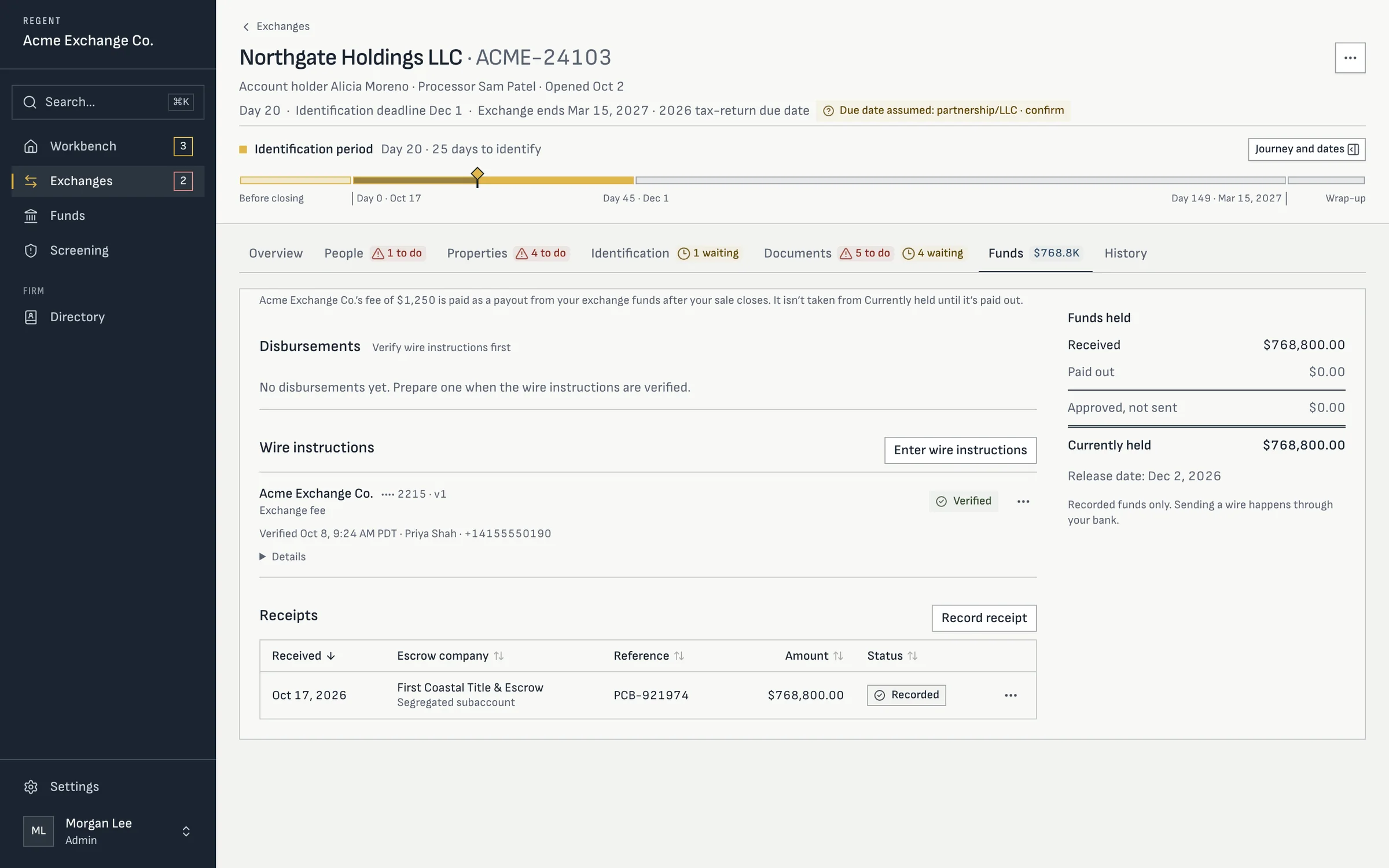
Wire instructions on a Regent file marked verified, with the date, time, the person called and their number
Verified instructions on a file: when the callback happened, who was called and on what number.

Screens from Regent today, with a sample firm and sample exchanges. Your workspace and portal carry your firm’s name and logo.

The escrow directory

Know the escrow officer before the wire.

Regent keeps a firm-wide directory of escrow and title companies, their officers and their phone numbers, each with the source it came from. Instructions verified once become known-good instructions for that company. When a new set arrives for a company you already know and doesn’t match, Regent flags it.

Payee names are matched against the beneficiary. Instructions from a free-mail address, with failed email authentication, outside your business hours, or for a new account at a company already on file raise a flag for a person to weigh.

Before the money moves

Stops that a busy afternoon can't skip.

Changed near the wire

Instructions that changed within 24 hours of the planned wire date stop the payout until they're verified again or the date moves.

Callback rules

A callback to a requester-supplied, wrong-party or caller-vouched number stops the payout, and no note can clear it.

Large amounts

Above your firm's threshold, a second person makes their own callback.

Outside the US

A receiving bank outside the United States stops the payout.

Separation of duties

The preparer and the caller can't approve unless an admin allows it, and loosening that needs a second person.

The exchanger signs off

The exchanger approves each payout by one-time code, e-signature, or paper checked by a second staff member.

If it happens anyway

An incident checklist on the payout itself.

  1. 01

    Alert and recall

    Alert your response team and ask the sending bank to recall the wire.
  2. 02

    Fraud desk and parties

    Call the receiving bank's fraud desk, and the parties on their known numbers.
  3. 03

    Law enforcement

    File an FBI IC3 complaint and contact the FBI field office.
  4. 04

    Confirm and record

    Reconfirm the recall and complete the incident worksheet.
  5. 05

    Insurer and counsel

    Notify your insurer and counsel, and foreign counsel if the money left the US.

Ten steps, modeled on the ALTA rapid-response checklist, each checked off with who did it and when.

Straight answers

Questions processors ask

Does Regent verify instructions automatically?
No, and it shouldn't. A person makes the call. Regent decides whether the call counts, from where the number came from and what was read back, and keeps the record.
Can an admin override a callback stop?
No. Most hard stops can be cleared by an admin with a recorded reason and another person's approval, but the callback stops are cleared only by making the right call.
Do exchangers send their own account details?
Payouts go to closing agents in the normal course. A return to the exchanger is its own purpose, and staff-entered exchanger accounts raise a flag.
Does Regent replace our bank's controls?
No. Your bank's own dual control and callback rules still apply when your staff send the wire. Regent adds the file-level controls in front of them.

Walk a suspicious wire through Regent.

We'll show what happens when the instructions change two days before closing, from the flag to the callback to the approvals.

Your team has a direct line to ours.